
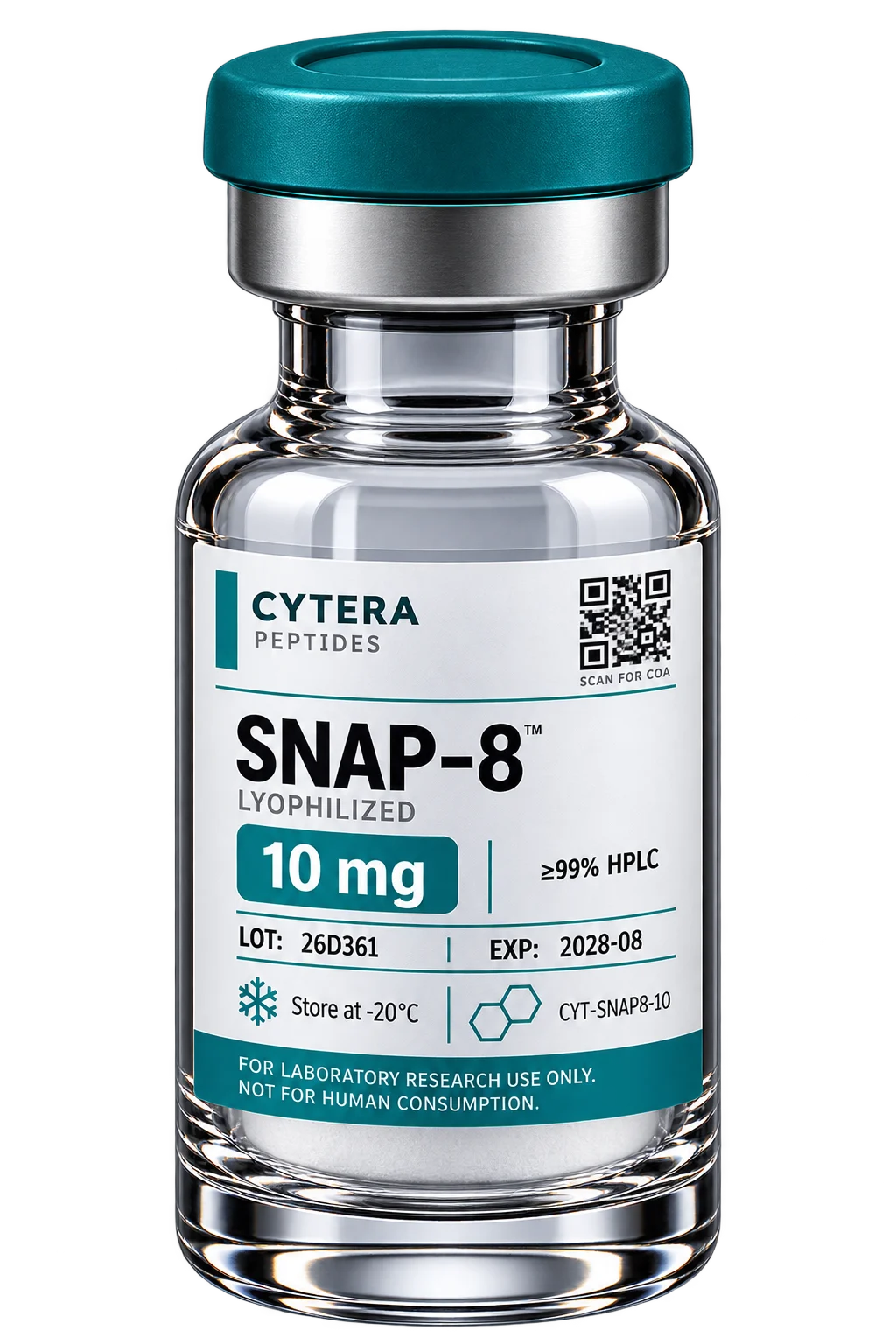
SNAP-8
SNAP-8 supplied as 10mg lyophilised powder, to a ≥99% (HPLC) purity specification with mass-spec identity. Documentation for your lot is available on request - quote the number printed on the label.
For laboratory research use only. Not for human or veterinary consumption.
- ≥99% Purity
- HPLC + Mass Spec
- Per-Lot COA
- Third-Party Tested
$39.00
/ 10mgFor laboratory research use only. Not for human or veterinary consumption.
Technical overview
About SNAP-8
SNAP-8 is supplied by Cytera Peptides as a lyophilised powder in 10mg vials, to a release specification of ≥99% purity by HPLC with identity confirmed by mass spectrometry. A specification is a claim - the proof for a lot is its certificate of analysis, available on request against the lot number printed on the label.
SNAP-8 is studied in the context of dermatological and cosmetic research. This SNAP-8 listing is intended for qualified researchers and laboratory purchasers, and everything below - specification, documentation, handling and ordering - is written for that reader.
SNAP-8 - technical overview
Acetyl octapeptide-3. The material ships as a white to off-white lyophilised cake under vacuum seal. Lyophilisation removes water by sublimation, which is what gives the dry powder its long shelf stability compared with material held in solution.
Purity and identity are two separate questions. Reversed-phase HPLC establishes purity as a percentage of total peak area; mass spectrometry confirms that the molecular weight of the principal peak matches the expected structure. Material can be 99% pure and still be the wrong compound, which is why a certificate worth reading answers both.
Synthesis is by solid-phase peptide synthesis followed by reversed-phase HPLC purification, then lyophilisation from a volatile buffer so that the finished SNAP-8 vial contains the peptide as a free-flowing cake with no residual solvent. Counter-ion and net peptide content are lot properties and belong on the certificate, not in marketing copy.
Available sizes and packaging
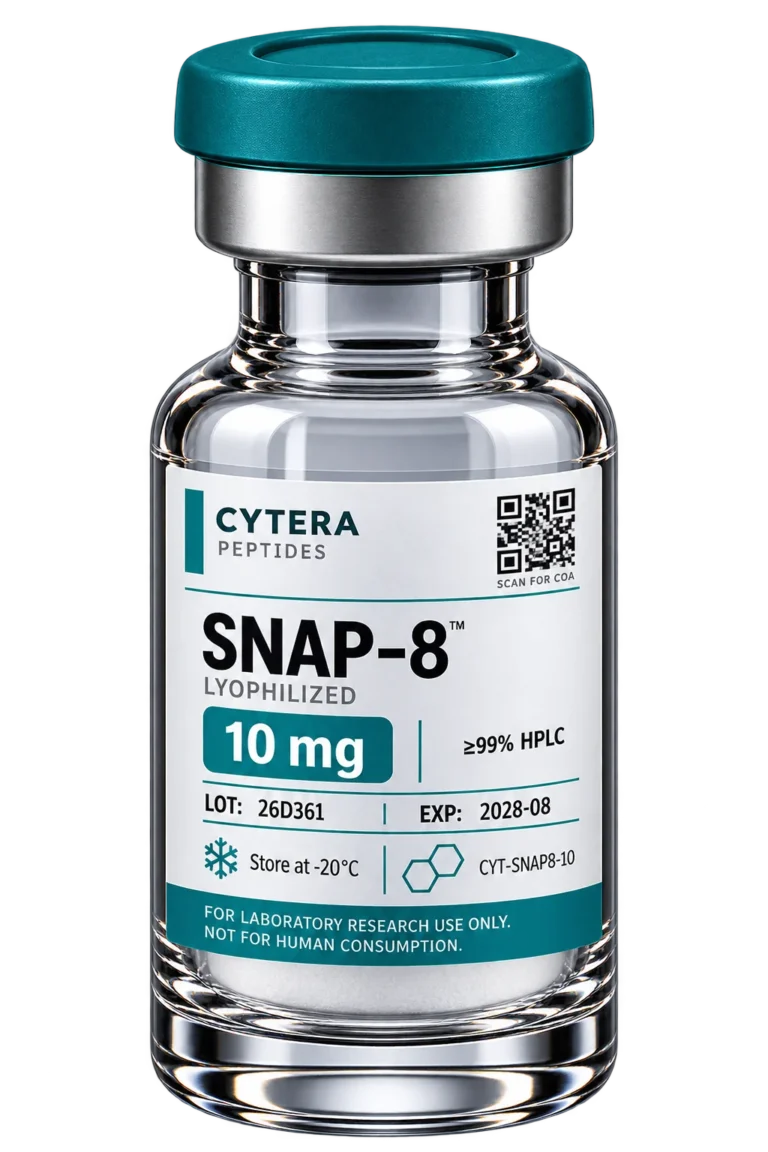
SNAP-8 is supplied as a single 10 mg vial. The fill mass is the nominal peptide content stated on the label; the measured net peptide content for a lot, where the laboratory reports it, appears on that lot's certificate.
Each vial is a 3 ml borosilicate glass serum vial with a butyl rubber stopper under a colour-coded aluminium flip-off cap - the cap colour identifies the research category at a glance on a crowded shelf. The label carries the compound name, nominal mass, lot number, a research-use-only marking and the Cytera lot code that documentation is filed against.
Specifications
The SNAP-8 specification below is the release standard every lot must meet before it is listed. It is not a measurement of any particular lot - the measured figures belong on that lot's certificate - but it is the standard a certificate is judged against.
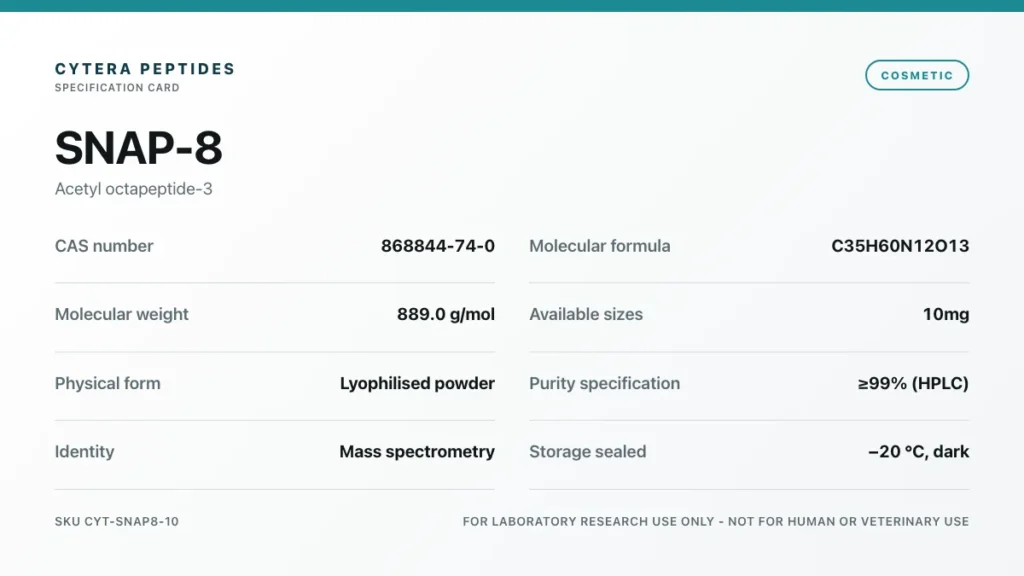
| Compound | SNAP-8 |
|---|---|
| CAS number | 868844-74-0 |
| Molecular formula | C35H60N12O13 |
| Molecular weight | 889.0 g/mol |
| Available sizes | 10mg |
| Physical form | Lyophilised powder |
| Purity specification | ≥99% (HPLC, area normalisation) |
| Identity specification | Mass spectrometry, principal peak vs expected mass |
| Storage - sealed | −20 °C, protected from light |
| Storage - reconstituted | 2–8 °C, short-term use; avoid repeated freeze–thaw |
| Category | Cosmetic |
Certificate of analysis
Certificates for SNAP-8 lots are published in the certificate library as they are issued. A certificate worth relying on states the assay result, the method used, the lot number and the date of analysis. If the lot you hold - or the lot currently on sale - is not yet listed, contact us with the lot number and we will tell you exactly what documentation exists for it.
This matters more in this category than in most. Purity claims are trivially easy to assert and difficult for a buyer to verify, which is why the useful question to put to any supplier - us included - is not "how pure is it?" but "show me the document for this lot." Our guide to reading a peptide COA explains what each line on a certificate means and which figures actually matter.
Reconstitution and handling
SNAP-8 arrives dry and must be reconstituted with bacteriostatic water before any measurement can be made. The resulting concentration depends entirely on how much solvent is added: the same vial can yield very different mg/ml figures. Our free peptide calculator works out concentration, draw volume and insulin-syringe units for any combination, and the reconstitution guide walks through the method step by step.
- Add solvent slowly against the inside wall of the vial, never directly onto the cake.
- Swirl gently to dissolve. Do not shake - foaming indicates denaturation.
- Return reconstituted material to 2–8 °C and avoid repeated freeze–thaw cycles.
- Keep the vial protected from light at all times.
Bacteriostatic water contains 0.9% benzyl alcohol, which allows a vial to be entered more than once. Sterile water contains no preservative and is single use only. Bacteriostatic water and reconstitution supplies are stocked alongside the catalogue.
Storage and stability
Sealed SNAP-8 vials should be stored at −20 °C, protected from light and moisture. Lyophilised peptides are stable for extended periods under those conditions because the hydrolysis and oxidation pathways that degrade a peptide in solution need water to proceed. Short excursions to ambient temperature - transit, bench time while weighing - do not materially affect the dry material, which is why lyophilised product ships without cold packs.
Once reconstituted the picture changes. SNAP-8 in solution should be refrigerated at 2–8 °C, kept away from light and used within a short window; repeated freeze–thaw cycles cause aggregation and loss of the intact peptide. If a protocol needs the material over weeks, aliquot the reconstituted solution once into single-use volumes rather than re-entering the same vial repeatedly.
Ordering SNAP-8 from Cytera
Orders for SNAP-8 placed before 2pm ET ship the same business day from within the United States, in discreet plain packaging with the lot number on the packing slip. Shipping is free on orders over $300. The how-to-order guide covers accepted payment methods, the minimum order and what happens after checkout.
Purchase of SNAP-8 is restricted to qualified researchers, laboratories and institutions. By ordering you confirm that the material will be used for in-vitro laboratory research only and that you are responsible for its lawful handling. Documentation for the lot supplied - certificate of analysis where issued, safety data sheet on request - is provided against the lot number on your label.
If you are comparing suppliers, our seven-point supplier checklist sets out the questions worth asking any vendor before ordering - lot-level documentation, identity testing, storage and shipping practice - and the legal position of research peptides in the US is explained separately.
Related research compounds
Researchers working with SNAP-8 in dermatological and cosmetic research also commonly source these compounds from the same category. Each has its own specification, documentation and reconstitution notes:
- Sermorelin - 10mg lyophilised powder
- BPC 157 Peptide - 5mg & 10mg lyophilised powder
- GHK Cu Peptide - 50mg & 100mg lyophilised powder
Browse the full Cosmetic research peptides category, or the complete peptide catalogue.
Published literature on snap-8
Researchers evaluating snap-8 typically begin with the primary literature. Indexed publications are searchable through PubMed. Cytera does not summarise or interpret findings, and nothing in this listing should be read as a claim about outcomes in any organism.
Frequently asked questions
What purity is this SNAP-8?
The release specification is ≥99% by reversed-phase HPLC, with identity confirmed by mass spectrometry. The measured figure for a specific lot belongs on that lot's certificate - ask us what documentation exists for the lot on sale before you order.
How much bacteriostatic water should be added?
There is no single answer - it sets the concentration. Use the calculator to find a dilution that puts your intended measurement in a readable range on the syringe.
How is SNAP-8 shipped?
Lyophilised powder is stable in transit at ambient temperature. Orders placed before 2pm ET ship the same business day from within the United States.
Can I see the COA for SNAP-8 before ordering?
Ask us - before ordering is exactly the right time. The certificate library is public and lot-searchable, and certificates appear there as they are issued. For a lot not yet listed, we will tell you what documentation exists for it.
Is SNAP-8 approved for human use?
No. It is supplied strictly for laboratory research and is not a drug, supplement or medical device. It is not approved for human or veterinary administration.
How should SNAP-8 be stored after opening?
Refrigerate reconstituted material at 2–8 °C, protect it from light, and avoid repeated freeze–thaw. Sealed lyophilised vials stay at −20 °C.
For laboratory research use only. This product is not a drug, food, supplement, cosmetic or medical device. It is not for human or veterinary consumption, diagnostic, therapeutic or any in-vivo use. Purchase is restricted to qualified researchers and institutions, and the buyer assumes full responsibility for safe and lawful handling.
Documentation
Certificates of analysis
Certificates for the current lot are published to the COA library as each batch clears independent testing. Quote the lot number printed on your vial to retrieve the exact certificate.
Browse the full COA library →Complete your setup
Reconstitution essentials
Lyophilised peptides require bacteriostatic water and sterile supplies for laboratory reconstitution.
-
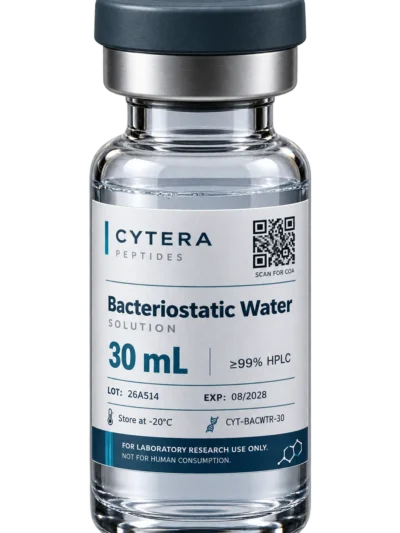 Bacteriostatic Water $12.00Add to cart
 -
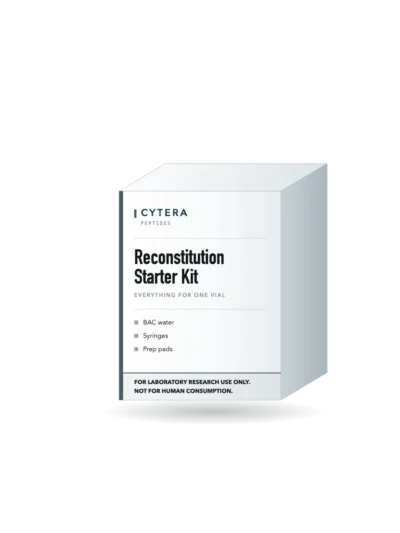 Reconstitution Starter Kit $29.00Add to cart
Related products
-
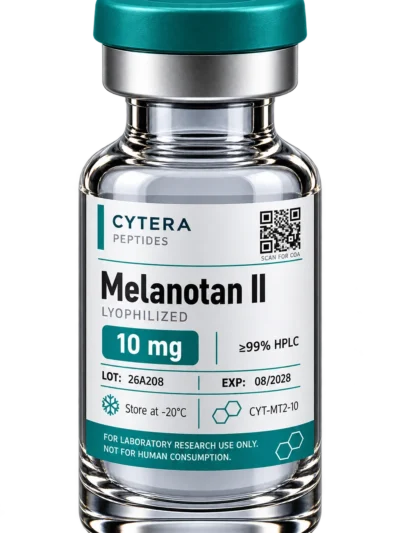
Melanotan II
$45.00 Add to cart -
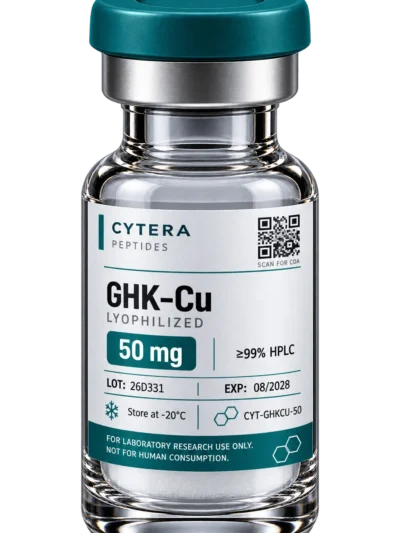
GHK-Cu
Price range: $49.00 through $79.00 Select options This product has multiple variants. The options may be chosen on the product page